This week, I want to name two forces that keep brilliant, experienced professionals stuck.
-
Employer age bias (it’s often unspoken, but it’s real).
-
The Gen X conditioning that makes many of us tougher on ourselves than any hiring manager.
If you’re in your early 50s or beyond, you don’t need a pep talk. You need a plan that makes you easy to choose.
That’s what this newsletter is: a 4-part plan you can start today to stay relevant, visible, and in control.
The “older” label is arriving earlier
A recent AHRC/AHRI research cycle has been widely reported in Australia, including the finding that almost a quarter of HR professionals classify workers aged 51–55 as “older.” And AHRC reporting also notes 1 in 5 HR professionals say their recruitment practices negatively impact older workers. Even though this data is from Australia, my global coaching reassures me that this is something my clients experience globally.
What that can look like in practice:
-
A resume gets screened out because it “feels senior” (even when it matches the role).
-
Interviewers probe “fit” and “energy” more than your actual track record.
-
The role scope quietly shifts to “someone with potential” rather than “someone who’s done it.”
None of this is fair. But it is predictable, and that means we can plan around it.
Waiting for your employer to keep you current is riskier than it used to be
The Committee for Economic Development of Australia (CEDA) has flagged that participation in work-related training in Australia has declined by 14% since 2007, and average training hours for those who participate have also fallen (reported as 17%). Translation: if you’ve been relying on your employer to keep you sharp, that pathway is shrinking. The market now rewards people who run their own upskilling program.
AI tools can compound bias
AI is already being used in screening and interview processes, and Australian reporting has highlighted risks of discrimination when AI is used to assess candidates. So while you’re modernising your approach, the goal is also to make sure an unchecked tool isn’t your first impression.
The Gen X, you are your worst enemy
There’s a particular behavioural pattern I see with Gen X clients, which can negatively affect their ability to find a job, and leave them open to ageism bias.
Many of us, myself included, were shaped by:
-
Independence early: “Don’t ask for help” becomes a default setting → the job search gets isolated.
-
Be tough: You underplay wins, you don’t advocate, you keep your stories too restrained.
-
Figure it out yourself: You are reluctant to invest in yourself, preferring low-risk/low-reward ad-hoc learning, random courses, with no strategic direction.
But here's the problem: The job market doesn’t reward private competence. It rewards proof, clarity, and signal.
A more useful reframe:
-
Asking for help is not neediness. It’s strategy.
-
Self-advocacy is not ego. It’s communication.
-
Learning is not “doing a course.” It’s building evidence that you can adapt fast.
Keep that in mind as you move into the plan (see below).

The 4-part plan to stay in demand and be chosen
Part 1: The Relevance Sprint (14 days)
Your objective: make your value obvious in 30 seconds.
Day 1–2: Pick your “problems you solve” (not your job title)
Choose 1–2, for example:
-
Stabilise critical projects that are off-track
-
De-risk transformations in regulated environments
-
Build stakeholder alignment in messy change
-
Fix operating rhythms and execution discipline
Day 3–7: Build a “Value Proof Kit”
Create:
-
Three CAR stories (Challenge–Action–Result)
Keep each one to 6–8 lines. Lead with the outcome. -
One-page case study
Title it like a business problem: “Reducing delivery risk in X months” -
A 90-second “Why me now” audio memo
This is practice, not content. Record it on your phone. Do it until it’s calm and crisp.
Day 8–14: Make it ATS- and human-friendly
-
Front-load keywords that match the role (not a keyword dump, a clean match).
-
Consider removing very old graduation years if they’re not required, while remaining truthful.
-
Tighten the top third of the resume so it reads like a business case.
This is where much age bias is either triggered or neutralised: the first impression.
You like done-for-you daily tasks? Invest in 31 Days of Action and see what a difference one month can make to your professional brand and job search readiness.
Part 2: Skills that compound (ongoing)
I like a “skills barbell” for experienced professionals:
-
One strategic skill (how work is changing): AI-assisted decisioning, data-driven operations, transformation governance
-
One execution skill (how you deliver now): prompting, dashboards, light automation, LLM-assisted analysis
Then use this structure:
30–30–30 rule
-
30% curated learning (one good course, not five random ones)
-
30% hands-on mini project (real output)
-
30% public artifact (a LinkedIn post, a slide, a short demo, a one-pager)
This matters more now because employer-provided training has declined over time.
Have you identified that job search knowledge is your learning need? Invest in Reset Your Career, and get my support for 6 recorded hours, plus sample resumes and CVs that work.
Part 3: Visibility without “self-promotion cringe” (90 minutes per week)
This is the minimum effective dose I recommend:
30 minutes: comment on 5 LinkedIn posts by target employers, leaders, or recruiters. Your comments should sound like a practitioner, not a cheer squad, and not like AI:
-
name the trade-off
-
offer a framework
-
add a practical example
30 minutes: publish one short LinkedIn post, translating your expertise into today’s problem set. You can literally reuse a poll format: “Which of these is the biggest risk in X?”
30 minutes: DM 2 warm contacts with something useful
A framework, a short voice note, an intro, a resource, a relevant observation.
Signal beats volume. Every time.
Afraid of LinkedIn: Join my private LinkedIn group for weekly support and advice from me. It's a monthly membership, and you can cancel at any time.
Part 4: Modern search mechanics (how people are actually getting hired)
Outbound first:
-
Pick 10 organisations.
-
For each, list 3 “hooks”:
-
a problem they’re facing
-
an initiative underway
-
a trigger event (new leader, restructure, new market, acquisition)
-
Referrals:
Aim for 2 warm intros per week. Script it simply: “If it’s easy, could you forward the note below to the right person?”
AI-aware applications:
-
Tailor the resume to the posting (keywords + order of responsibilities).
-
Then humanise the accompanying email: context, relevance, and a clear ask.
Interview narrative:
Two lines that can quietly neutralise unspoken age assumptions:
-
Learning velocity: “In the last 90 days I shipped X using Y new tool.”
-
Time horizon: “I’m excited about a three-year arc to deliver…”
These address the fears underlying age bias: adaptability, runway, and energy.
Worried your message is not landing well? Book a 1-hour session with me, bring all your job-search and career questions and issues, and let's address them together.
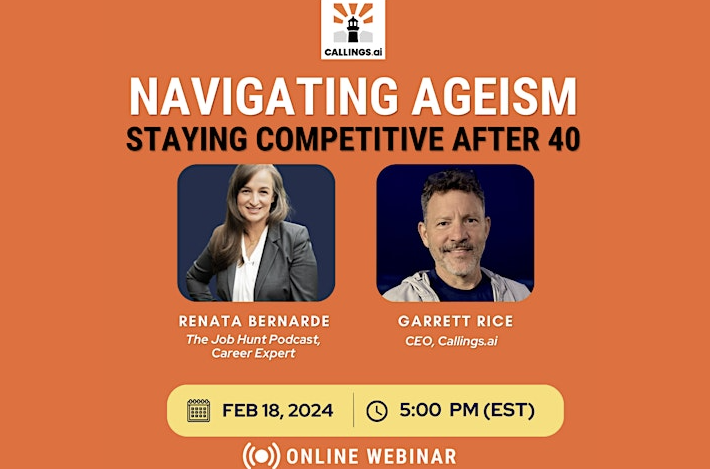
Last-minute invitation: Ageism webinar
If this newsletter hit a nerve, you’ll want to join me live tomorrow. I’m delivering a webinar together with Callings.ai's CEO, Garret Rice, on Navigating Ageism and Staying Competitive After 40.
- US EST: Wed Feb 18, 2026 at 5:00 PM
- Melbourne/Sydney/Canberra (AEDT): Thu Feb 19, 9:00 AM
- London (GMT): Wed Feb 18, 10:00 PM
If you’re a job seeker (or supporting one), come along.

Time Out
- Travel: We spent 3 days in Port Fairy, a charming coastal town about 3 hours away from Melbourne. We love the drive, staying at our Friend's beautiful home, swimming in icy-cold water, and going for a stroll in this historic town, with its pretty heritage-listed buildings and cottages. Follow me on Instagram to see what I do outside work.
- Reading: In preparation for spending quite a lot of time in the UK this year, I am reading Outlander, and have borrowed the second book in the Wolf Hall series. Chances are, these two series will keep me busy all year.
- Listening: Driving to and from Port Fairy, we listened to a lot of Djo, Olivia Dean, Novos Baianos, and Baby do Brasil Consuelo.
Next week, we get super serious about AI. You are probably reading about it in the news; the new versions of the mainstream AI tools are sophisticated beyond belief. It will affect our careers, and we will investigate how to prepare for it.
Until then, wishing you all the best
RB