It's been hard to avoid artificial intelligence this week, even if you tried.
At the United Nations General Assembly in New York, AI became part of the conversation between world leaders. President Trump used the term “super intelligence” and argued against slowing American development of the technology, while UN Secretary-General António Guterres called for stronger safeguards. A day later, leaders from some of the major AI companies appeared before the UN Security Council themselves and warned about the security risks associated with increasingly powerful systems.
These are very different positions on how AI should be governed, and those debates will continue. You and I have almost no control over how governments eventually regulate AI, which companies will dominate it, or how capable these systems will become.
What we can think about is what all of this means for our careers.
I work predominantly with professionals in their 40s, 50s, and 60s. If that is you, there is a reasonable chance that you will still be working ten or twenty years from now. I don't think the useful question is whether AI will affect your career. It already is. The better question is what you should be strengthening now so that your experience continues to be valuable as the tools become considerably better.
I think the answer comes back to judgment.
Information is becoming cheaper. Judgment isn't.
AI has made competent information extraordinarily easy to obtain.
You can ask a tool to summarize a report, prepare questions for a meeting, analyze a job description, create a presentation, draft an email, research a company, or produce something that resembles a perfectly respectable LinkedIn post.
That is wonderful. I use these tools too, and I think experienced professionals should learn how to use them well.
But something interesting happens when everybody has access to the same capability. Producing the information stops being much of a differentiator.
Knowing what matters becomes more important.
What do you believe should be done? Which information is credible? What context is missing? What happened the last three times an organization tried something similar? What is the machine failing to understand about the people involved? When the available options are all imperfect, which one would you choose and why?
Those are questions of judgment, context, and pattern recognition. For experienced professionals, they are also where decades of work should give you an advantage.
This is one of the reasons I have been talking about writing so much with clients lately.
Writing makes your thinking visible.
I learned something about my own writing recently
A few weeks ago, a regular reader sent me a thoughtful note about this newsletter. He said he enjoyed my work but preferred editions that felt more like I wrote them myself. He noticed the one-line paragraphs and familiar rhythms that have become common in AI-generated writing.
I agreed with him.
I had adopted the short-paragraph format because I kept reading that it was better for mobile devices. Lots of successful newsletters use it, and the advice behind it made perfect sense.
The problem was that I never particularly liked it. I like essays. I like paragraphs. I like staying with an idea long enough to work out what I actually think about it.
His email made me realize that I had followed a supposed best practice while ignoring my own judgment about the people I write for. And I should know better, because I am actually a reasonable version of my own ideal reader.
There is a career lesson in that too. We are surrounded by best practices about LinkedIn, networking, résumés, interviews, leadership, AI, and career advancement. Some are excellent. Some are excellent for someone else.
The more senior you become, the less your value comes from obediently following the playbook. At some point, you need to know enough to decide when the playbook doesn't apply.
Writing is one way to practice thinking for yourself
When I encourage clients to write, I am not suggesting that everyone needs to become a content creator.
I don't want you publishing three LinkedIn posts a week because somebody told you the algorithm requires it. You certainly do not need an opinion about every development in your industry.
But if you have accumulated twenty or thirty years of professional experience, I would like to know what those years have taught you.
Writing forces you to find out.
An idea can sound very clever inside your head. Then you try to explain it in 500 words and discover that there is a hole in the argument. You remember an experience that contradicts what you originally believed. You realize that something you have repeated for years no longer feels true.
That is useful work even if nobody ever sees what you wrote.
And if you are between jobs, there is an additional benefit. You may have temporarily lost many of the places where people used to encounter your thinking: meetings, presentations, conferences, leadership discussions, and conversations with colleagues. Writing can keep your expertise visible while you are outside an organization.
This week's YouTube video takes this idea one step further because the technology itself is beginning to change.
Claude has started using a statistical form of watermarking in some generated text. This does not mean recruiters can suddenly put your résumé into an ATS and discover that Claude wrote it, but it is another indication of where things are heading: AI-generated material is becoming more traceable, while employers are also developing clearer rules about where candidates may and may not use AI.
My argument in the video is not that you should stop using AI. Quite the opposite. I show how I would use it heavily for research, gap analysis, structure, and preparation, while retaining authorship of the actual message. The distinction I make is between allowing AI to help with your writing and allowing AI to do your thinking for you.
For experienced professionals, that distinction is really important.
Your career may become less tidy too
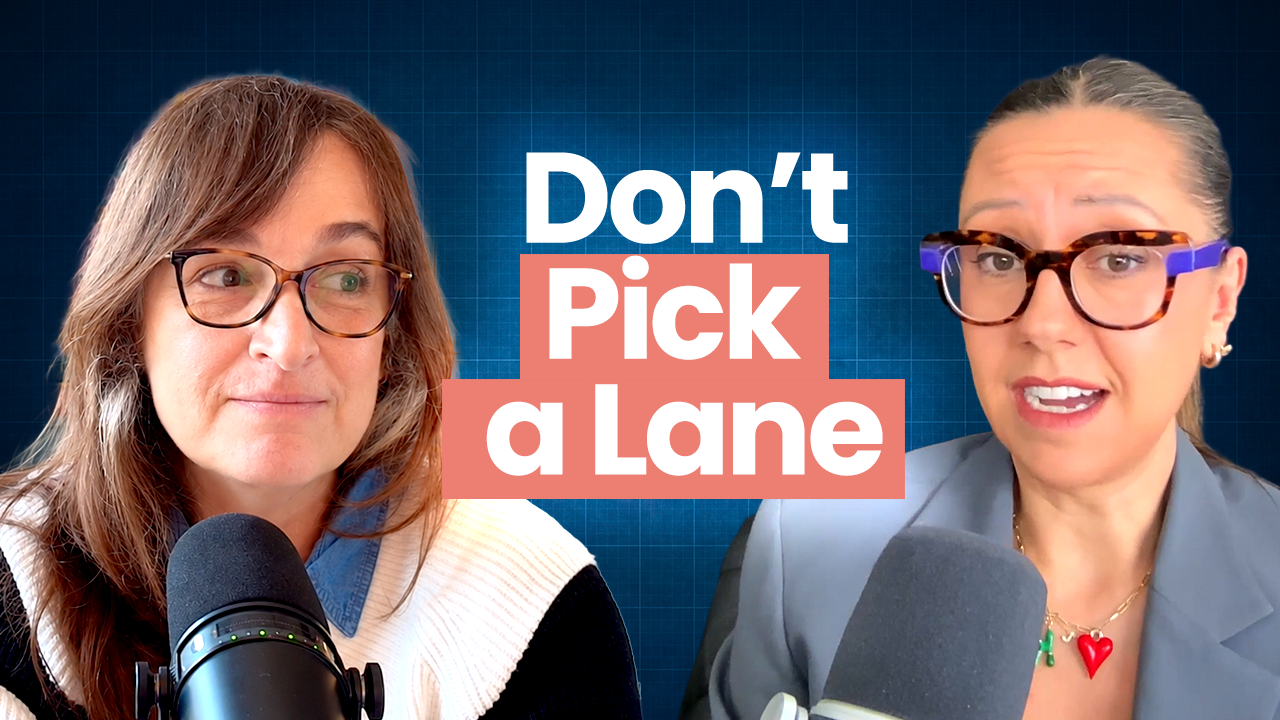
This week's podcast conversation with Kate Dillon comes at the same question from another direction.
Kate has built a career that refuses to fit neatly into one box. She has been a lawyer, entrepreneur, strategist, speaker, adviser, and mentor, often combining different forms of work rather than abandoning one identity and starting again.
One of the ideas I particularly liked from our conversation was that we rarely start from zero. Experienced professionals carry accumulated skills, relationships, knowledge, and what Kate calls "muscle memory" from one context into another. The opportunity is to become more conscious about which parts of that experience can be repackaged to create value somewhere new.
That feels very relevant to the AI conversation.
Over the next decade, some jobs will change significantly. Some tasks will disappear. New ones will emerge. Organizations will make mistakes about what they automate, and some will discover that expertise they thought they no longer needed was actually rather important. Kate and I discussed this problem: deciding what work should be augmented, what should be automated, and what people should continue to own.
None of us can design a ten-year career plan with certainty in that environment.
What we can do is become better at learning, experimenting, building relationships, articulating our value, and carrying our expertise from one context into another.
And we can get better at showing people how we think.
For you this Friday
Try this: choose one issue in your field that you have a genuine opinion about. It could be something your industry is getting wrong, something that has changed during your career, or a problem you have solved often enough to recognize the pattern.
Write 300 words about it. Don't start by asking AI to write it for you. Start with your own messy thinking. Dictate it if staring at a blank page makes you miserable.
Once you have something that is genuinely yours, use AI as an editor:
- Ask what is unclear.
- Ask where your argument is weak.
- Ask what evidence is missing.
- Ask what a skeptical colleague might challenge.
Then decide what you agree with. The machine can give you an answer, but your career will still depend on knowing what you think about it.
How I help
Much of my work with experienced professionals connects to this question: what value remains distinctly yours?
Sometimes we uncover it while repositioning someone for a new role. Sometimes it shows up in their resume, LinkedIn profile, interviews, writing, or thought leadership. Sometimes a client realizes that the next stage of their career needs to look quite different from the previous one.
The objective is not to compete with AI at producing information. That would be a rather exhausting competition. It is to make your experience, judgment, relationships, and point of view easier for the right people to recognize.
If that is something you are thinking about in your own career, let's talk!
Book a free introductory meeting
This week on YouTube: How I would use Claude in a job search now
Claude's new text watermarking has caused some unnecessary panic. In this video, I explain what the technology actually does and show the workflow I would use with Claude today: research the employer, diagnose gaps between the role and your experience, develop the structure of your application, and use AI to challenge your writing without handing over authorship. The bigger question isn't whether you should use AI, but which parts of the work should remain yours.
Watch now & subscribe to our YouTube channel
 =
=
This week on The Job Hunting Podcast: Building a career that doesn't fit neatly into one box
My conversation with Kate Dillon is about portfolio careers, experimentation, transferable skills, and creating more value from the experience you already have. We also discuss why professionals may need to become more comfortable with ambiguity as AI changes knowledge work, and why learning how to unlearn could become an important career capability.
Please leave our podcast a 5-star review wherever you listen. It's the best gift you could ever give me, and it has a HUGE impact on my work. Thank you.
Give us a 5-star rating on Spotify
Write us a 5-star review on Apple
Time Out
- Watched The Love Hypothesis on Amazon. Is it predictable? Yes. Was it a fun watch? Also yes.
- Keeping an eye on the NYT top 100 series ever made. So far, they have released 61 to 100, and I am delighted to see The OA make the list. Such a weird plot, but so worth watching. Some of my all-time favorites are also there, including Better Things and Halt and Catch Fire. The others so far deserve to be there, too. One that I want to watch is Justified, because I adore Timothy Olyphant and this series has completely passed me by.
- I'm happy people have rediscovered Julia Stiles, now that she's competing in Dancing with the Stars. A very talented, underrated actress. Her most recent work as the protagonist in Riviera was chef's kiss. A series to escape into and enjoy the locations.
If you have been thinking about writing something yourself, I hope you do. Even if nobody sees it. There are worse ways to spend half an hour than giving your brain somewhere to put its thoughts and your hands something useful to do.
Until next week
RBX