The hidden job market and the job ad are not opposites
A few weeks ago, I prepared a webinar on the hidden job market. I ended up not presenting it. Here's why.
The organisers wanted a session focused on jobs that are found without ever being advertised, where networking is the main route into work. I understand that this happens. Of course it does. But that has never been the main focus of my work as a career coach.
Most of the professionals I support are looking for roles in medium to large organisations. These are companies, government agencies, universities, and not-for-profits with formal recruitment processes, internal approvals, and due diligence requirements. In those environments, roles are usually advertised.
And yet, the hidden job market still exists. Even if you want those roles.
This is what I want to discuss today.
Because if you think your task as a job seeker is to find the ad, tailor your resume, and click Apply, you are missing what is happening under the surface.
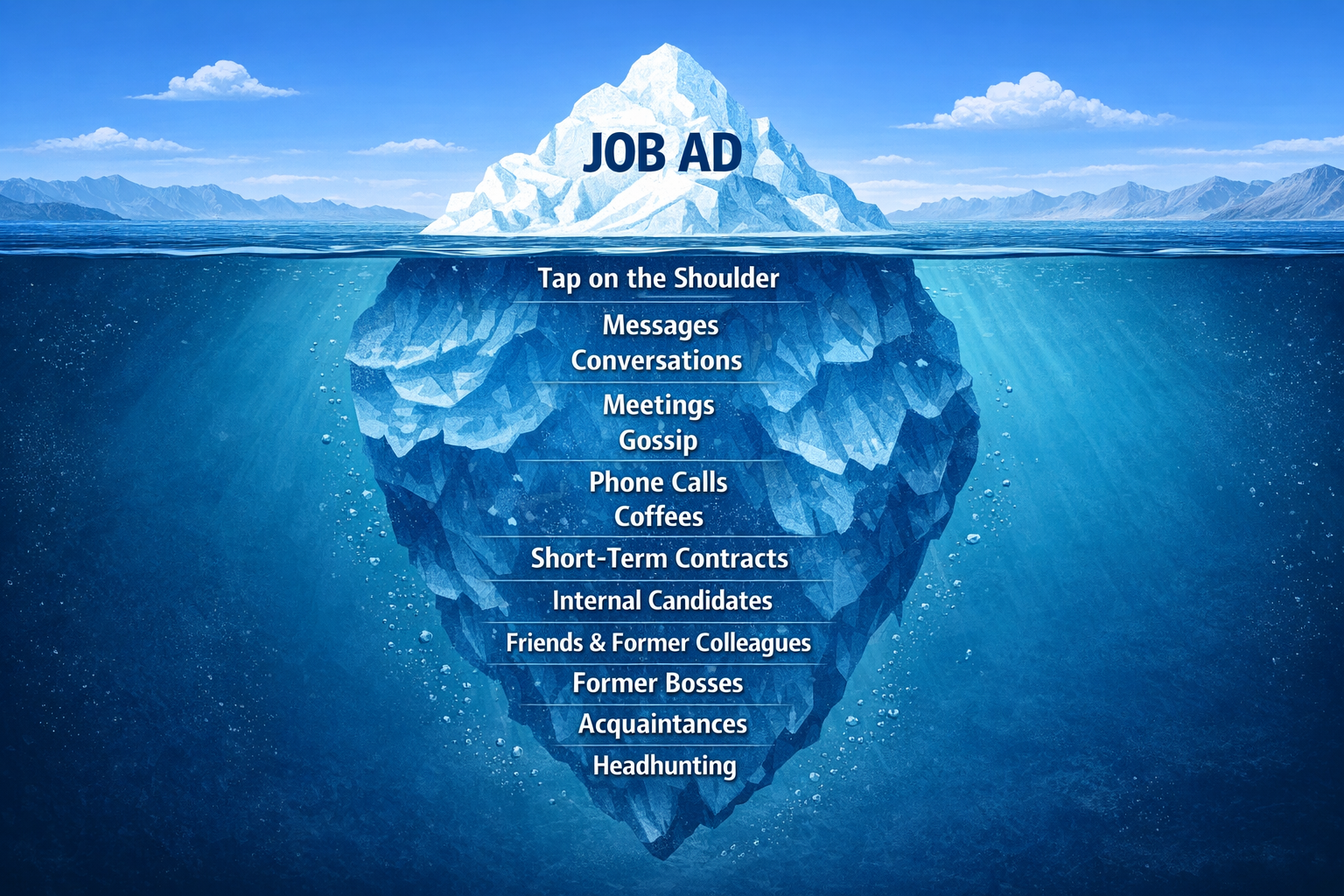
The job ad is the visible tip of the iceberg.
Below the surface are all the things that shape the opportunity before, during, and after it is posted: conversations, messages, informal meetings, headhunting, internal candidates, short-term contracts, colleagues talking to colleagues, former bosses recommending people, recruiters sounding out the market, and decision-makers clarifying what they really need.
That’s the hidden job market I believe in.
Not a mysterious secret club where all good jobs are handed out behind closed doors.
Not a fantasy where you never have to apply for anything.
And certainly not a suggestion that the formal application process doesn’t matter.
What I see, over and over again, is that the best candidates do not ignore job ads. They approach them with context.
They understand that by the time a role is advertised, the employer has already done a great deal of thinking. Someone has identified a problem. A team has discussed what kind of person might solve it. There may already be internal contenders. A recruiter may have been briefed. Stakeholders may have weighed in. The wording of the job ad may have been shaped by concerns you cannot see at first glance.
When you apply without understanding that context, you are applying blindly.
This is why strong professionals can spend hours tailoring a resume and still hear nothing back.
The issue is not always the quality of the application.
The issue is that the application has been prepared in isolation.
I want to be very clear here. I am not telling you to go and “network for jobs” in an awkward, transactional way. I am not asking you to message random strangers and ask them to get you hired. That approach rarely feels good, and it rarely works well for experienced professionals.
What I am suggesting is more strategic and far more practical.
I want you to treat every important job application as part of an ecosystem.
That means asking:
- Who already knows this organisation from the inside?
- Who has worked there before?
- Who supplies to them, consults to them, or works with them?
- Who in my network may know the hiring manager, the team, or the function?
- What has happened recently in this business that might explain the role?
- What are they likely to care about that is not obvious in the ad?
Sometimes the intelligence is simple but powerful.
A former employee tells you the team is under pressure and needs someone calm and steady, not flashy.
A recruiter tells you the organisation is looking for stakeholder management more than technical expertise.
A friend says the outgoing leader was very operational, but the business now wants someone more strategic.
A former colleague explains that the role has been advertised before and the employer is wary of candidates who look impressive on paper but cannot work across silos.
Can you see what happens then?
You stop writing a generic application.
You stop repeating your career history.
You stop trying to cover everything you have ever done.
Instead, you present yourself as the answer to a specific problem.
That is what improves conversion from application to interview.
And that, in my view, is where the hidden job market becomes useful.
- It gives you an advantage around the job ad.
- It helps you understand the role before you apply.
- It helps you tailor your examples more effectively.
- It helps you speak the organisation’s language.
- It helps you decide whether the opportunity is worth pursuing at all.
- And, in some cases, it helps your application land in front of someone who already has a sense of who you are.
This is particularly important for experienced professionals.
When you are earlier in your career, a job search can be more transactional. You meet the criteria, you submit the documents, and you hope to be shortlisted.
When you are more senior, hiring is rarely that simple.
Senior roles carry greater perceived risk. Employers are not only hiring capability. They are hiring judgment, fit, presence, credibility, and trust. They want to know whether you can operate in their context. The job ad only tells part of that story.
So what should you do differently?
Here is the simple version.
When you see a role you care about, do not rush to apply in the first 20 minutes.
Pause.
Read the ad carefully.
Look for clues about what is really being asked.
Then spend a little time activating the ecosystem around it.
- Reach out to one or two people who may know the organisation or the function.
- Ask thoughtful, low-pressure questions.
- Seek perspective, not favours.
- Gather enough insight to sharpen your case.
- Then apply.
- And after you apply, do not disappear.
If it feels appropriate, let relevant people know you’ve put your application forward. Stay visible. Follow up professionally. Keep the conversation alive.
That is very different from “networking your way into a job.”
It is closer to doing your homework properly.
It is what good candidates do when they understand how hiring really works.
The reason I care so much about this topic is that many professionals are being told one of two unhelpful stories.
- The first is: Just apply online and hope for the best.
- The second is: Stop applying and network your way into the hidden job market.
I don’t think either view is complete.
For most of the people I work with, the real answer sits in the middle.
Apply for good roles. Take the formal process seriously. But never treat the job ad as the whole story. Because it isn’t.
If your applications are not converting into interviews, the problem may not be your experience, your age, or even your resume.
The missing piece may be that you are applying without enough market intelligence, without enough proximity to the opportunity, and without enough understanding of what sits below the surface.
That is fixable.
And once you learn how to do it, your applications become more focused, more convincing, and more competitive.
Do you want help clarifying your job applications so they lead to more interviews?
You can book a consultation with me.
I work with professionals who want a smarter, more strategic approach to job search, especially when the stakes are high and the market feels tough.
You do not need to do more for the sake of doing more.
You need to understand the ecosystem your application is entering, and learn how to position yourself accordingly.
Book a 1h Consultation with Renata AUD400 (Approx. US290)

The Feedback on This Episode Has Been Amazing!
Episode 333: Why Workers Over 45 Are Being Left Behind has resonated with so many listeners, clients, and recruiters. The post I did on LinkedIn brought in new subscribers and clients, which means this type of content - talking about how to find work in your 40s, 50s and beyond - is just right for my audience
If you haven’t yet listened to the full conversation with Michele Lemmens and Rebecca Hall, I encourage you to do so.

Time Out:
- This is so unlike me, but I haven't watched any TV for weeks! I am running out of things to say in my Time Out, and I know you want to know what I have been up to. Basically, just doing nappy changes (Teddy, my grandson, loves it when I do it! At least this is what everyone has been telling me, and I've fallen for it! LOL) and cooking up a storm between my coaching sessions keeps me so busy there's no time left for anything else.
- We went to Lincoln Cathedral last Saturday to see Elijah by Felix Mendelssohn. It was an unforgettable experience. The cathedral is over 100 years old, enormous. The choir had about 200 singers, great soloists, an amazing orchestra, and a magnificent organ. Nothing compares to listening to music designed for the space it's played.
- You can follow along by following my Stories on Instagram :)
Thank you for reading this newsletter. I hope you found it useful. Reach out if you need help with your career.
Otherwise, I'll see you next week
RB