Over the years, workplace culture has become the quiet deal-breaker for experienced talent. It’s no longer a buzzword trotted out in recruitment ads. It’s the deciding factor in whether a professional will join your company or walk away, regardless of the paycheck. Increasingly, I see my clients decide that their reasons for changing roles are no longer driven by ambition or compensation, but by something more fundamental: culture.
In my recent interview with workplace culture expert Zrinka Lovrencic for The Job Hunting Podcast, we discussed what separates great workplaces from the rest. Her insights, built on decades of organizational research and consulting with companies across Australia, offer a compelling framework for understanding the shift we're seeing in today's job market. But they also reveal a troubling disconnect: despite all we know about building great cultures, too many organizations are still getting it wrong.

Understanding Culture in 5 Steps
1. The Culture Fallacy: Saying One Thing, Doing Another
Nearly every company claims to have a great culture. As Zrinka noted, “They believe they have a great culture. Whether they've measured that or not is a different question.” This illusion is perhaps the most dangerous misalignment in modern hiring. Companies showcase glossy values on their websites, but fail to embed them into actual systems of leadership, performance, or accountability.
This creates a minefield for job seekers. Many of my clients have accepted roles based on promises of inclusivity, flexibility, or innovation, only to discover a culture mired in micromanagement, outdated norms, and performative leadership. One red flag Zrinka mentioned stuck with me: if your manager isn’t a coach, if they’re not invested in your growth and success, it’s a problem.
Professionals who’ve spent decades building their careers now find themselves at square one, asking the hard questions: “Is this where I can thrive?” “Will I be respected here?” “Is the culture real or is it just marketing?”
2. Hybrid Work: Flexibility or Lip Service?
The conversation around flexibility has evolved, but not always matured. While two to three days in the office has become the new norm, some leaders remain fixated on outdated models of visibility and presenteeism. The fallout is real. In the recent Victorian state election in Australia, analysts linked a major party’s loss to their early resistance to flexible work arrangements for government employees. People voted with their feet, and with their ballots.
My clients are doing the same. “Five days in the office? Forget it,” one said recently. “I’ll keep looking.” It’s not about avoiding work. It’s about avoiding inefficiency, wasted hours commuting, and rigid mindsets that refuse to acknowledge a post-pandemic reality. Smart employers are responding accordingly. Others will lose out on talent they desperately need.
3. Beyond the Paycheck: The Mental Health Cost
It’s easy to dismiss talk of culture as soft. But the costs are quantifiable. High turnover. Burnout. Missed innovation opportunities. As Zrinka put it, “Your mental health has a price on it.” The best companies understand that. They know that great culture isn’t built only when times are good. It’s most critical when times are hard.
She shared a story of SAS Institute, where the founder ensured no layoffs during downturns, because they had planned for rainy days. That kind of leadership builds loyalty that spreadsheets can’t measure. And in a world of growing uncertainty, loyalty is the currency every employer should be banking on.
4. What Today’s Professionals Are Really Looking For
Here’s what’s changed: today’s job seekers are no longer just job seekers. They are evaluators. Strategists. Cultural auditors. They’re not just reading the job ad but reading between the lines. They’re assessing how the company defines flexibility, how diversity is lived, not just listed, whether performance feedback is annual or ongoing, and whether leadership is accessible or hiding behind bureaucracy.
And they are willing to walk. I’ve seen senior professionals reject lucrative offers because the culture didn’t feel right. That would have been unthinkable a decade ago.
5. The Leadership Mandate for 2025 and Beyond
As we move deeper into a hybrid, AI-augmented, post-pandemic working world, culture will not become less important—it will become more so. Managers and team leaders now carry an unprecedented responsibility: to connect with employees they may not see every day, to create community, not just compliance, and to lead with clarity and compassion, not control.
The best companies are already investing in developing these skills, not just in their HR teams but across every leadership layer. Culture isn’t HR’s job alone: it’s everyone’s job, especially in lean times.
Give your career a reset and walk away with a standout LinkedIn and resume.
If you purchase my short course, Reset Your Career, between now and the end of June, I’ll gift you a free 30-minute chat with me. Once you’ve worked through the course and updated your LinkedIn and resume, we’ll meet to review your progress and fine-tune it together. If you need to do anything extra, just enroll in the course, and I’ll contact you to organise our session. It’s a great opportunity to get my personalized feedback and ensure that your career documents are working for you.

Actionable Strategies for Job Seekers
If you are a corporate professional seeking a new role in 2025, I encourage you to approach your job search like a due diligence exercise. Know your values. Understand your work style. Ask hard questions in interviews. Don’t be swayed by titles or logos. Be swayed by trust, alignment, and how you feel when you talk to their people. We are in the midst of a culture reckoning. And only the organizations that embrace it with humility and intention will thrive.
1. Define What Culture Means to You
Before starting a job search, reflect on the environments where you thrive. Ask yourself:
-
What values are non-negotiable for me?
-
What kind of leadership brings out my best work?
-
How much structure versus autonomy do I need?
Write these down. Use them to assess future opportunities.
2. Do a Culture Audit During Your Job Search
Zrinka recommends researching companies extensively before applying:
-
Review their "About Us" and "Careers" pages.
-
Look for stated mission, vision, and values.
-
Cross-check employee reviews on platforms like Glassdoor.
-
Review LinkedIn profiles of current employees. Are they thriving and progressing?
3. Ask Sophisticated Culture Questions in Interviews
Use your interviews not just to answer questions, but to assess culture. For example:
-
How are your company values implemented and rewarded?
-
What does flexibility mean here, and how is it managed?
-
What opportunities exist for cross-functional collaboration or secondments?
-
How many hours of L&D are offered to employees each year?
These questions show strategic intent and signal that you're evaluating the company as much as they are evaluating you.
4. Spot Red Flags Early
Zrinka shared some warning signs that may indicate a toxic culture:
-
Lack of regular feedback: Reviews only once a year are not enough.
-
Poor management support: If your team leader isn't coaching you, that’s a concern.
-
"We're like a family": This phrase can mask dysfunction. Look for a team-based, community-driven culture instead.
-
Lack of follow-through on diversity or inclusion promises.
Normalize high standards for how you're treated at work. Disrespect, lack of support, or feeling undervalued are not "just how things are."
Listen to this week's episode:
|
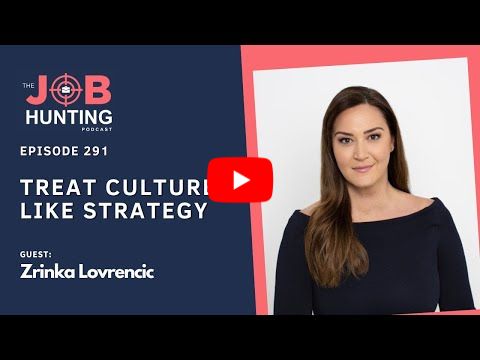
“Great workplaces don’t happen by accident.” This quote from Zrinka Lovrencic says it all. And she knows culture, after 18 years in the realm of "Great Places to Work" in Australia, an annual award I always looked forward to reading about. If culture, values, and purpose are important to your job search and career, you will enjoy this conversation
Listen now:
- Listen to the full episode on the podcast website
- Listen on Apple Podcasts
- Listen on Spotify
- Listen on Audible

Time Out
- I am beyond happy we have a new science fiction TV show to watch. Murderbot delivers for me. It's high-tech and low-tech, and it's the future like it could become: a rogue robot security guard who loves soap operas. I'm hooked. It's 98% on Rotten Tomatoes.
- I accidentally found out that there is now a Tiny Desk Concerts Japan, and I love it. I have listened to NPR Tiny Desk concerts since their inception in 2008; it's great to watch with the kids and share my favorites with them. I hope other countries take it up as well. So far, this is my favorite concert of the Japanese concerts. I love the dissonant sounds, rhythm changes, great bass, improv, and just how cool these kids are.
- We went to Port Fairy last weekend. It has become a favorite destination for us, both because the nature there is magical, and also because we love spending time with our friend who lives there. If you get a chance, go to Port Fairy.
If this newsletter helped you:
- Please help me raise awareness for the newsletter. You can forward it to other professionals who may benefit from it. I will be forever grateful to you. They can click here to subscribe.
- Visit my website for more information about my courses and coaching, which are designed to help you achieve your career goals.
To your career success
RBX
Renata Bernarde | Career Coach | Host, The Job Hunting Podcast