Most senior professionals are used to being competent. You know your domain. You understand internal politics. You can read stakeholders and adjust your message. You can deliver outcomes.
Job searching removes many of those stabilisers.
You are operating with limited information. You do not know the internal decision criteria. You rarely get real feedback. You are asked to compress years of leadership experience into a few short stories. And you often feel watched while simultaneously feeling invisible.
This is why so many job seekers expend significant energy trying to manage their inner experience. They try to force confidence. They try to think positively. They try to eliminate nerves. They try to stop worrying. They try to sound polished at all times.
That approach is exhausting and unrealistic. It also sets a trap: “I’ll take action when I feel better.”
The alternative, and the core message of this week's episode, is that you don’t need perfect thoughts to take effective action.
Alex Cohen, Senior Sports Psychologist at the United States Olympic and Paralympic Committee, works with high-performance athletes, including ski and snowboard athletes. We'll review 2 strategies he uses with athletes and apply them to your job search.
1: Thoughts vs attention, stop fighting your mind and start steering it
Alex Cohen describes performance readiness as having two components. The first is understanding the difference between thinking and attention.
Thinking includes any thoughts, feelings, sensations, images, memories, or internal commentary that might disrupt focus.
Attention is what you hand your mind to, moment by moment.
He uses a simple example: if someone throws a water bottle at you, you might have the thought, “Why did he throw that?” But the part of your mind that reaches out and catches it is attention. Thoughts are commentary. Attention is action.
I see this distinction transform job seekers, as many assume they can perform well only if their thoughts are “right.” They tell themselves:
If I’m confident, then I’ll apply.
If I stop worrying, then I’ll network.
If I feel calm, then I’ll interview well.
Real life doesn’t work like that. You can feel nervous and still show up prepared. You can feel disappointed and still take the next step. You can have the thought “I’m not good enough” and still submit a strong application.
The goal is not to eliminate thoughts. The goal is to aim your attention.
Alex describes it perfectly: those thoughts and feelings want to go down the hill with you. They can. Your job is to aim your attention.
Real-world job search examples
Before an interview, especially a video interview, thoughts often show up as:
What if I blank?
I’m not as strong as the other candidates.
I really need this job.
My voice sounds weird on video.
If you believe those thoughts must disappear before you perform, you end up in a fight with your own mind. That fight drains you.
Instead, treat those thoughts as noise that can exist in the room, then ask: Where am I placing my attention?
Place attention on something useful:
-
The question being asked
-
The structure of your answer
-
The example you will share
-
The outcome you want the interviewer to understand
After rejection, thoughts often show up as:
I’m never going to get there.
I’m too old.
The market is impossible.
I’m failing.
You do not need to win against those thoughts. You need to decide where attention goes next:
-
Review what you learned
-
Ask for feedback (when appropriate)
-
Update the next application
-
Reach out to one person
-
Take one measurable action
In networking, thoughts often become very loud:
I don’t want to bother people.
They’re too senior.
I’ll sound awkward.
I don’t know what to say.
Aim attention at what matters:
-
Curiosity
-
One good question
-
Listening
-
Understanding their world
-
Offering something relevant
Your nervous thoughts can come along for the ride. Your attention stays on the task.
2: Internal vs external focus, how to unlock clarity in interviews and conversations
The second major concept is that attention can be internal or external. This is where “flow state” becomes relevant.
Internal focus is biomechanical or self-focused cues. It is the “how am I moving?” type of attention.
In job searching, internal focus sounds like:
Am I speaking too fast?
Do I look nervous?
Is my answer good?
Am I coming across as smart?
Should I be more polished?
What should I do with my hands?
Some internal awareness helps with preparation, but during performance, internal focus often makes people stiff. It increases self-monitoring. You start narrating your performance instead of doing the performance. You become less present. Less clear. Less connected.
External focus uses something outside of you as the cue. In sport, Alex’s examples are simple and memorable:
Instead of “push your knees out” (internal), focus on “push your knees against the band” (external).
Instead of “explode with your legs” (internal), focus on “push through the floor” (external).
The environment gives attention a target.
For job seekers, external focus cues point attention to:
-
The listener
-
The problem
-
The outcome
-
The impact
-
The decision the other person needs to make
-
The example that proves value
External focus cues are short phrases you can use to direct attention outward when you feel yourself spiralling inward.
Near external focus vs far external focus
Alex also differentiates between near external and far external focus.
Near external focus is still somewhat technical, but it is external. It’s what you focus on in the next 60 seconds.
Far external focus is more tactical and big picture. It’s what you focus on across the whole conversation.
Translated for job seekers:
Near external focus:
-
Answer this question clearly.
-
Use a simple structure and land the result.
-
Ask the next question.
Far external focus:
-
Build trust.
-
Create clarity about fit.
-
Move them toward the next step.
-
Make it easy for them to advocate for you internally.
This is leadership communication, applied to recruiting. You are not just delivering information. You are helping someone make a decision.
Actionable strategies for experienced professionals and executives
This is where I want you to move from insight to execution. Below are the practical steps I recommend, especially for senior candidates facing higher stakes, more complex stories, and greater internal pressure.
Strategy 1: Use the “Name it, then aim it” reset
This is the simplest and most powerful tool in the episode.
Step 1: Name what’s happening internally.
-
I’m noticing anxiety.
-
I’m noticing doubt.
-
I’m noticing pressure.
Step 2: Aim your attention.
Ask: What’s the most important thing right now?
Then pick one target:
-
In an interview: Answer with a clear example.
-
In networking: Ask one thoughtful question.
-
In applications: Tailor the top third of the resume to match their priorities.
This works because it stops the internal wrestling match and returns you to purposeful action.
Strategy 2: Build an external focus cue plan for your job search
Write three external focus cues and keep them visible. Put them in your notes app. Put them at the top of your interview preparation document. Put them on a sticky note next to your screen.
One cue for interviews
One cue for networking
One cue for applications
Examples:
-
Interview cue: Give one clear example with a result.
-
Networking cue: Be curious, ask one great question.
-
Application cue: Match their priorities in the top third.
If you want to elevate this further, add one far external cue to each:
-
Interview far cue: Help them picture me in the role.
-
Networking far cue: Build trust and stay top of mind.
-
Application far cue: Earn the interview.
Strategy 3: Separate preparation from performance
High performers often blur these two.
Preparation is where internal focus can help: practise, refine, get feedback, adjust structure, tighten language.
Performance is where external focus helps most: be present, communicate clearly, connect, and land the point.
A practical way to do this:
-
In preparation: record yourself once, then take notes on structure, not personality.
-
In performance: stop monitoring yourself and focus attention on outcomes.
Strategy 4: Use an executive-grade answer structure to reduce mental load
When your attention is under pressure, structure becomes your best ally. You want a structure that holds you steady without making you sound scripted.
A simple approach for senior candidates:
-
Headline: the point you want them to remember
-
Example: one story, not five
-
Result: outcome, metric, impact, risk reduced, revenue gained, time saved
-
Relevance: why this matters for their role
This aligns perfectly with external focus. You are not trying to sound impressive. You are trying to make your value easy to understand.
Strategy 5: Use external focus cues to improve LinkedIn outreach
Most outreach fails because it is internally focused. It is written from the job seeker’s anxiety.
External focus improves tone instantly. It shifts the goal to making it easy for the other person to respond and participate.
Use this external cue before you hit send:
Make it easy to say yes.
Practical approach:
-
One clear reason you are reaching out
-
One specific question
-
A small request (10 to 15 minutes, not “can you help me”)
-
Low-pressure closing
Common mistakes to avoid
The episode covers three mistakes that I see constantly:
-
Using these tools only when you feel good
These tools exist for the moments you don’t feel good. -
Turning external focus into pressure
External focus is not “perform perfectly.” It is “place attention on what helps you execute.” -
Confusing preparation with performance
Preparation is practice and refinement. Performance is presence and outcomes.
Future outlook: why attention skills will matter more in the next few years
Recruitment is becoming more compressed, more automated, and more ambiguous for candidates, particularly at senior levels, where processes can involve multiple stakeholders, long timelines, and shifting role scopes.
At the same time, leadership expectations continue to rise. Employers want executives who can communicate clearly, make sense of complexity, and influence across the organisation.
That combination means attention management will become a career advantage.
Not as a wellness trend, but as a professional capability.
If you can reliably direct your attention to what matters, even when your thoughts are noisy, you can:
-
Interview with more clarity
-
Network with more confidence
-
Recover faster after rejection
-
Present your leadership story with precision
-
Make decisions without spiralling
This is the kind of inner discipline that supports outer performance. It is also a skill you can practise, measure, and improve.
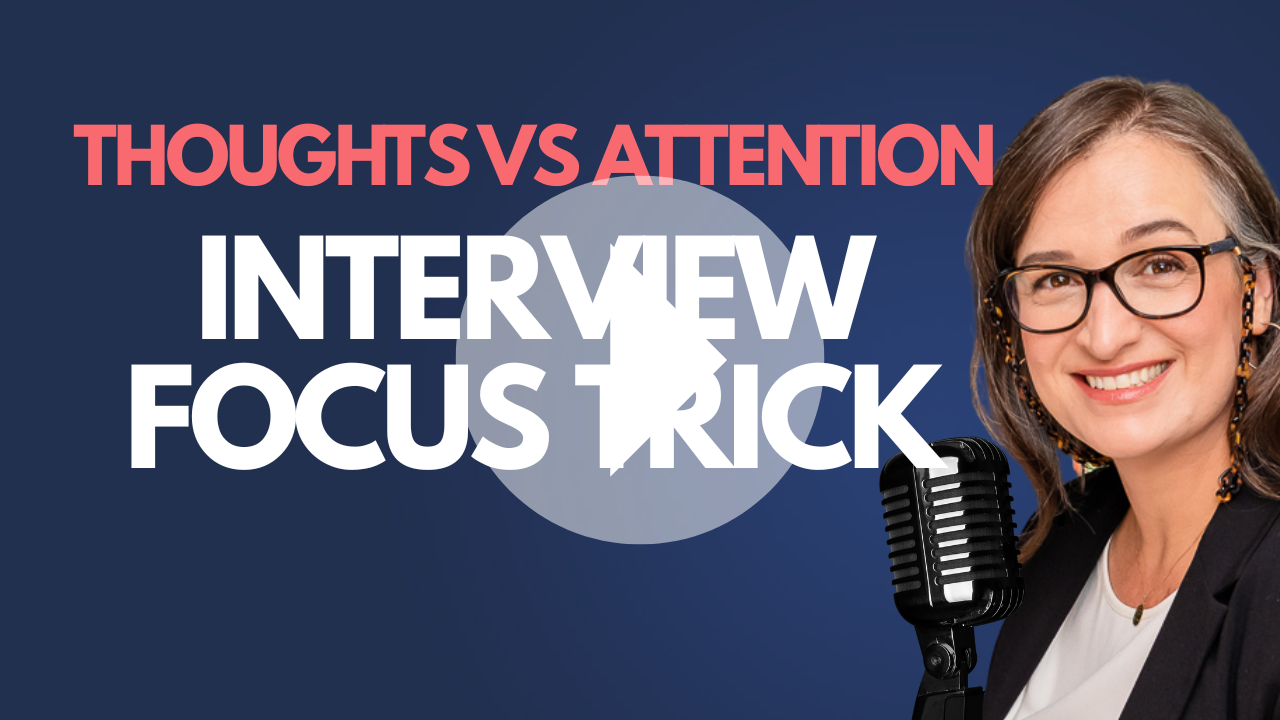
Episode 328 Is For High-Performance During Job Search
This episode is built on two simple ideas from elite sport psychology that translate beautifully to job searching:
-
There’s a difference between thoughts and attention. Thoughts can come along for the ride. Your job is to aim attention.
-
Attention can be internal or external. In high-stakes moments, external focus cues help you perform more smoothly and communicate more clearly.
If you take one thing from this, let it be this: you don’t need perfect thoughts to take effective action.
Job hunting is a performance environment. The goal is not to feel fearless. The goal is to perform effectively, even when your mind is noisy.

Time Out
- We have been watching the Winter Olympics, which inspired me to record this week's episode. We usually start with the Wide World of Sports YouTube channel for highlights of what we missed, then move on to whatever is live in the evening.
- Here in Australia, we have the Australian Football League, and we are consistently working to grow an international audience and engage other countries with what we call Aussie Rules football. So, I am a bit confused about the issue with the biggest artist on Earth singing in Spanish at the biggest American football event. For sure, it should bring a new audience, no? Anyway, I loved it. Such a joyful performance, even if I didn't understand a word of it. I am with Elmo, and I think he's a Good Bunny. This article unpacking the show is very interesting.
- Talking about Elmo, it was not in my bingo card that Elmo would have beef with Taylor Swift. It takes courage to go against Swifties, and only Elmo can pull this off. But apparently, she befriends a rock in her latest music video, and Elmo has a rock nemesis. Read this if you want to be in the know. And like all things Taylor Swift, there's a huge story behind the video, explaining all the cameos, and it's also a pretty good one. You can find out more about it here.
In next week's newsletter, I will be sharing with you an essay I wrote over the holidays about job searching as a member of Generation X, born in the 70s. I think many subscribers will relate to what I am suggesting are the biggest roadblocks for my generation.
And by the way, if you want to share your feedback, thoughts, or ideas with me, or ask questions about my coaching or courses, all you need to do is reply to this email!
If you're ready to work with me, I am ready to help you. Click here to learn more, or reply to this email so we can get started.
All the best, and until next week
RB