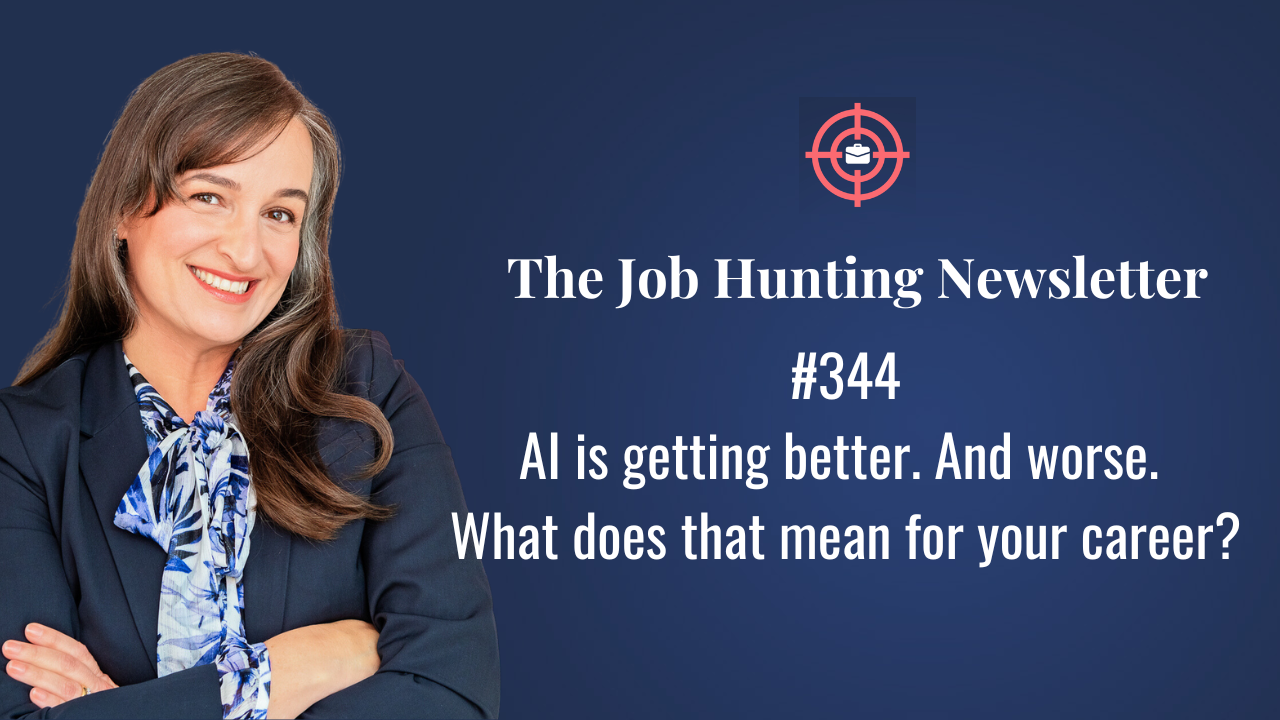
A conversation with Jon Whittle on what comes next for white-collar work
I recently sat down with Professor Jon Whittle, one of Australia’s leading AI experts, to discuss what many of you have been asking me privately:
Is AI about to replace us?
And if not, what exactly is it about to do?
If you’ve been following the headlines, you’ve likely seen:
- Predictions that white-collar work could be automated within 18 months
- Claims that generative AI will collapse the “price of intelligence”
- Software engineers saying their craft is being replaced by tools like Claude
- Entry-level hiring declines linked to AI
- And more recently, criticism of AI companies like OpenAI (ChatGPT) and Anthropic over partnerships with the US defense sector
It’s a lot. And for experienced professionals in their 40s, 50s, and 60s, the anxiety is not abstract. It’s practical. You’re job searching. You’re leading teams. You’re planning the second half of your career. So I asked Jon to cut through the extremes.
“All predictions about AI are wrong.”
Jon has worked in AI for 30 years. He joined NASA after his PhD, with a mandate to build AI capable of writing software for space missions.
He failed.
Not because he lacked capability. Because the technology wasn’t ready. Now, suddenly, AI can write software in minutes. When I asked him about claims that white-collar work could disappear within 18 months, his response was blunt:
“AI is a field of extremes. One camp says everything will change immediately. The other says it will destroy humanity. The truth sits somewhere in the middle.”
He reminded me of past predictions:
- In 2013, Oxford researchers said 47% of jobs would soon be automated. Employment rose.
- In 2016, Geoffrey Hinton suggested we should stop training radiologists. Demand increased.
AI changes tasks. It rarely erases professions overnight. But that doesn’t mean nothing is happening.
The part that is changing fast
According to Jon, the most significant disruption is not chatbots. It’s software-writing AI. Tools like Claude Code and OpenAI’s coding systems can now generate functional applications in minutes. For engineers who have dedicated their lives to mastering code, this feels existential. Not only a threat to employment.A threat to identity. That distinction matters. Because much of what professionals are feeling right now isn’t fear of redundancy. It’s the fear of irrelevance.
Entry-level decline: Is AI already replacing jobs?
Research shows a 16% decline in entry-level hiring in the US since ChatGPT launched. But the story is more complicated. Interest rates rose at the same time. Tech firms had overhired during the pandemic. Some layoffs attributed to AI may actually reflect broader business corrections. AI may be accelerating shifts, but it’s unlikely to be the sole cause.
What this means for professionals over 40
Jon’s advice to experienced professionals was not to “panic” or “ignore it.”
Instead, experiment. Intentionally.
Not every tool.
Not every week.
But deliberately.
AI fluency for a non-technical leader does not mean coding.
It means:
- Understanding what the tools can realistically do
- Knowing where they fail
- Identifying which parts of your workflow are augmentable
- Being able to lead humans who use AI
- And managing the cultural and governance implications inside organisations
He was clear: the biggest barrier to AI adoption is not technology. It’s organisational culture. And professionals who understand both capability and constraint will be valuable.
The ethical unease no one is talking about enough
Then we discussed the part that’s harder to articulate. OpenAI and Anthropic have both faced criticism for partnerships with US defense agencies. For many professionals, this creates discomfort. You use ChatGPT to draft strategy documents. You refine board papers with Claude. You coach your team using AI prompts. And then you read that these same companies are building systems for military use.
It raises real questions:
- Are we complicit?
- Is usage endorsement?
- Do we opt out?
But here’s the truth: Large technology companies have always served both civilian and government clients. AI is no different. The question becomes less about abstaining from tools and more about:
- Understanding how your data is used
- Knowing your organisation’s AI governance policies
- Choosing tools aligned with your risk tolerance
- Participating in the broader ethical conversation rather than disengaging from it
Avoidance does not equal influence. And professionals who understand the ethical landscape will be more valuable than those who simply disengage.
The real risk: skill stagnation
Here is what struck me most: Jon is not predicting mass unemployment in 18 months. But he is predicting skill divergence.
Some professionals will:
- Integrate AI into workflows
- Increase productivity
- Lead hybrid teams of humans and AI systems
- Move up the value chain
Others will:
- Avoid experimentation
- Stay attached to manual processes
- Frame AI only as a threat
- Become less competitive in hiring markets
The gap may widen.
Not between humans and machines.
But between humans who adapt and humans who freeze.
So, what should you actually do?
If you are a white-collar professional over 40, here is my practical interpretation of this conversation:
- Do not catastrophise headlines.
- Do not dismiss the pace of change.
- Pick one tool and use it deeply for 30 days.
- Map your role into three categories:
- Tasks AI can already do
- Tasks AI can support
- Tasks that require judgment, trust, influence, and negotiation
- Double down on the third category.
Because AI can write code.
But it cannot:
- Take responsibility in a boardroom
- Repair damaged stakeholder relationships
- Negotiate complex human trade-offs
- Build trust across conflicting interests
- Own outcomes
And organisations still need accountability.
A final thought
When the internet arrived, many of us believed certain industries would vanish (including me!). They changed, adapted, and grew. I sold my travel business, thinking its days were counted. They were not. The business is still operating. I freaked out too quickly.
AI feels faster. It feels more intimate. It touches cognitive work directly. But history suggests that transformation is uneven. The professionals who will thrive are not the most technical. They are the most adaptive.
Your understanding of AI will influence your employability in the coming decades. Not because robots will replace you overnight. But because the market will reward those who can operate confidently in this new environment.
Get help
If you want more structured guidance on how to position yourself in an AI-influenced job market, work with me. I would love to have a consultation with you to figure out the best way possible for your situation. Or we can work together for 3 months and really become more efficient at positioning you in the job market for the decade ahead.
For now, don’t panic.
But don’t sit still either.
About Jon Whittle
Jon Whittle is Australia's leading thought leader on AI for business. He hosts the podcast CSIRO Presents Everyday AI and is the author of two books on AI: Responsible AI: Best Practices for Creating Trustworthy AI Systems and AI for Business: A Guide to AI Adoption. He regularly advises Boards and C-suite leaders on AI adoption, and he is a former NASA senior engineer and director of Australia's national facility for R&D in AI, cybersecurity, robotics, and quantum technologies.

Time Out
- Last week I did a course that uses the same platform I use for my courses (Kajabi). I loved how easy and user-friendly this platform is. I can watch the videos on my phone, take notes, and it's great. I did a strength training course for people with hypermobility (me!). It's super hard, so having a course, rather than doing one session with the physio, means I can go back to it many times. Hypermobility leaves you stretchy and very prone to injuries. I am keen to get stronger this year, fingers crossed. I hope that my courses for job seekers and career-driven professionals are just as interesting and easy to follow as this one.
- What I am listening to: How beautiful is This Woman's Work, by Kate Bush. There are some artists from the 80s and 90s I am only now falling in love with. Kate Bush's catalogue, above and beyond her most famous songs, is one of them. And in Brazil, Marcos Valle, whom I hardly listened to back then, is now on high rotation. He is the most sampled musician in my home country. You will find bits and pieces of his songs in many famous songs from J-Z, Childish Gambino, and Kanye.

How to work with me when I'm booked out
March and April are great months for job seeking, networking, and prospecting for future opportunities. So it's no wonder my week is booked out with clients interested in doing consultations or starting their ongoing coaching programs with me.
If you are struggling to find a time in my calendar, here are your options:
- Start with Reset Your Career: A course designed to help experienced professionals get ready to send a job application or attend a job interview, fast. Can be done over the weekend, or in 1 full day.
- Book a LinkedIn Audit: An optimized profile will do wonders to boost you up in the recruiter's searches and short lists. I will do it in my own time and get back to you within 10 business days.
- If you have an emergency and need my help, reply to this email, and I will try my best to squeeze you in.
- Click here to learn about all my services, so you can choose the best one for you. If you have any questions, please reply to this email.
Until next week, and wishing you all the best
RB