This week, I want to speak directly to experienced professionals who feel ready for a new chapter yet are unsure where to begin. The job market has shifted, the way recruiters find candidates has changed, and the tools we use to communicate our value now include artificial intelligence. To unpack what this means in practice, I invited Georgie Hubbard, founder of Safe Solutions, to be my guest on the podcast. She's a recruiter who pivoted across industries and later launched her own agency. Together, we dug into the mindset, methods, and modern tools that can transform a scattered search into a targeted, confident campaign. This newsletter distills our conversation into a practical, step-by-step playbook you can apply right away.
Why this conversation matters now
High performers are often told to keep their options open, apply widely, and trust that volume leads to results. In today’s market, that approach creates noise without traction. Spray-and-pray applications rarely survive modern filters. Recruiters are increasingly using platform tools to surface profiles that match. Hiring teams are pressed for time, which means clarity and alignment matter more than ever.
This week's podcast episode is all about navigating change with intention. Georgie and I explored how to identify transferable skills, tailor your resume and LinkedIn to specific opportunities, close capability gaps with targeted upskilling, build confidence through small bold moves, and use AI to accelerate, not replace, the human work of career growth.
Key shifts in the market and what they mean for you
- From mass applications to precision alignment: The old idea of applying to dozens of roles per week is giving way to focused, high-quality applications. Applicant tracking systems and platform algorithms scan for alignment with skills and requirements. If your resume and LinkedIn profiles do not mirror the language of the target role, you will likely be filtered out before a human sees your profile.
- Recruiter workflows are increasingly platform-driven: Recruiters can now upload a job description to platforms like LinkedIn and surface candidate profiles that algorithmically match the role. This means two things for job seekers. First, your profile needs to be findable through the keywords and phrasing used in the role description. Second, your profile must read like a credible answer to a specific problem, not a generic career summary.
- Confidence and clarity beat waiting for the perfect time: Georgie’s career shifts underline a pattern many of us recognise. There is never a perfect time to pivot. Confidence grows as you act, not before. Waiting until life is less busy or risk-free prolongs uncertainty, whereas small bold steps build momentum and create proof points that open doors.
- Upskilling is targeted and lightweight: You do not need a new degree to pivot. Short courses, micro credentials, and hands-on projects that demonstrate capability are often enough. The key is choosing the right gap to close and making the evidence of that upskilling visible in your portfolio, resume, and profile.
- AI accelerates assets and workflows: AI will not do your career strategy for you. It can, however, help you quickly draft, organise, and polish your career assets. From synthesising a job description into a skills checklist to producing a first draft of a portfolio case study, AI reduces friction so you can spend more time on high-value activities such as stakeholder outreach and interview preparation.
Real-world examples from Georgie’s journey
Georgie pivoted from beauty to tech recruitment by inventorying her transferable skills, then validating which were in demand. She scanned job descriptions, highlighted overlaps, and tailored her materials to signal that alignment. Later, she made the leap to start Safe Solutions by taking deliberate, risk-aware steps rather than waiting for perfect certainty. She framed the decision using two questions: what is the worst case, and how would I handle it? What is the best case, and what steps would make it more likely? That dual framing helped her move from analysis paralysis to forward motion.
She also described how recruiters search in practice. When a new role lands, a recruiter might upload the job description into LinkedIn’s tools, then review a shortlist of profiles surfaced by the platform. Profiles that echo the role’s language and quantify achievements rise to the top. Profiles that are broad, narrative-heavy, or missing recent, role-specific keywords often get skipped.
Finally, Georgie emphasised that mid- and senior-career professionals have a structural advantage. Experience compounds. Your pattern recognition, judgment, and relationship capital are assets that many organisations need. The task is to package those assets so decision-makers can quickly connect your capabilities to their business goals.

13 Actionable strategies you can implement this week
- Build a one-page strategy before you change a single line of your resume: Write down the specific role titles you are targeting over the next 6 to 12 months. Under each title, paste three to five job descriptions that represent strong, realistic targets. Highlight the repeating capabilities, tools, and outcomes. Create a skills map: what you can already evidence with strong proof points, what you can evidence with some polishing, and what you must close as a gap. This one page becomes the source of truth for every update you make to your resume and LinkedIn.
- Tailor your resume to one role at a time: Use the language of your target job description to structure your resume. Create a top section listing core capabilities and tools in the employer's phrasing. Under each role in your experience section, include three to five impact statements that quantify results aligned to the target role. Avoid generic responsibilities. Show business outcomes, scale and scope, stakeholders, and tools or methods used. If you pursue multiple role types, maintain separate versions. Do not dilute alignment by cramming every strength into one master document.
- Make your LinkedIn profile searchable and skimmable: Your headline should communicate a value proposition tied to the roles you are targeting. Include core keywords from your skills map. The About section should be short, focused, and outcome-led, with a few indicative metrics. For each role, list visible achievements that mirror the language and results of your target postings. Activate the Featured section to surface your best evidence. Add a portfolio link, a case study slide deck, or a short thought piece. If you only have PDFs, upload them directly so that proof is one click away. Too confusing? Don't have the time? Book a LinkedIn Audit with me.
- Turn job descriptions into checklists and use AI to speed the work: Copy a target job description into your preferred AI tool and ask it to extract the core competencies, technical requirements, and outcomes. Ask for a comparison against your resume text and LinkedIn About section, highlighting gaps and suggesting phrasing that remains truthful. The AI output is a draft. Edit for accuracy, tone, and integrity. Use it to reduce rework and maintain consistent alignment across materials.
- Close one high-impact capability gap with a microcredential or project: From your skills map, choose the most visible, high-value gap. Complete a short course or certification, then build a small project that demonstrates its application. Examples include a process optimisation case for operations roles, a competitive analysis for product or strategy roles, or a stakeholder map for transformation roles. Package the project into a two-page PDF with context, actions, and outcomes. Add it to your Featured section.
- Replace spray-and-pray with a weekly pipeline routine: Design a cadence that includes three pillars: targeted applications, proactive outreach, and content that signals credibility.
- Targeted applications: submit two to four role-aligned applications per week. Each application should reflect tailored resumes and minor cover letter adjustments that speak to business priorities evident in the posting. You can book a consultation with me to learn the recipe of how to do this successfully.
- Proactive outreach: for every application, identify two to three people connected to the role, such as the recruiter, hiring manager, or a peer in the team. Send a short note that references one business priority and links to a relevant proof point.
- Credible content: once per week, publish a short LinkedIn post about a common problem in your target function, along with a practical framework you have used. Keep it helpful and specific.
- Prepare for modern screenings and interviews: Expect short recruiter screens focused on alignment and availability, followed by competency interviews that test your thinking. Build a story bank of eight to ten impact narratives using a simple structure: context, specific actions, metrics, and stakeholders. Practice aloud. Use AI to generate mock questions from the job description and rehearse answers that connect your evidence to each requirement.
- Treat consulting or business building as a parallel path, not a binary switch: If you are between roles or curious about independent work, test a small services offer aligned to your skills. Package it into a one-page capabilities sheet. AI can help you draft the first version of a brochure, a simple contract template, and a pitch deck outline. Keep scope small and outcomes specific. Early engagements create new proof points that strengthen your candidacy for permanent roles or help you intentionally grow an independent practice.
- Rebuild confidence with small bold moves: Confidence returns through evidence. Choose actions that provide quick feedback: request one warm introduction each week, volunteer for a short advisory call, or present a 15-minute brown-bag on a topic you know well. Track inputs and outcomes. The habit of decisive action compounds into momentum.
- Audit your digital footprint: Search your name and title combinations. Clean up older content that no longer reflects your brand. Align profile imagery and banners across platforms. Ensure your contact information is easy to find. If you have public talks, articles, or board work, make sure links are current and accessible from your LinkedIn Featured section.
A focused approach for executives
Senior candidates often face two specific challenges. First, breadth can make it harder to signal a crisp fit. Second, achievements are sometimes described at too high a level. If you are targeting executive roles:
- Clarify the scope with numbers. Headcount, budget, revenue influence, geographical remit, and portfolio complexity are essential signals.
- Translate strategy into measurable outcomes. Show how your decisions changed cost curves, revenue trajectories, risk posture, or customer metrics. Even directional numbers are useful when exact figures are confidential.
- Demonstrate stakeholder leadership. Outline boards, regulators, unions, vendors, and enterprise functions you have influenced, and how you built alignment.
- Show transformation proof. Document two or three programmes where you delivered change from design to steady state. Include timelines, milestones, and adoption metrics.
- Make succession and team development visible. Executives who build capability are prized. Summarise how you developed leaders and strengthened pipelines.
The next few years and how to stay ahead
AI-enabled matching will continue to refine how candidates are surfaced. This will reward professionals who maintain living profiles calibrated to their target roles. Short, targeted learning will become the norm. Employers will value leaders who can blend human judgment with data-informed decision-making and manage cross-functional teams (AI and human) in rapidly changing environments.
To stay ahead, keep three disciplines:
- Continual calibration: Every quarter, refresh your skills map using fresh job descriptions in your target areas. Update keywords and proof points accordingly.
- Portfolio thinking: Capture your work as modular assets. Case studies, playbooks, and talks can be repurposed for interviews, onboarding, and thought leadership.
- Relationship compounding: Maintain a simple system for keeping in touch with your network. Offer help, share insights, and ask thoughtful questions. Relationships create opportunities long before a role is posted.
What to do if you are stuck right now
If you want expert support tailored to your situation, here are practical ways we can work together this month.
- Strategy consultation: A focused 60-minute session to diagnose your roadblocks and map a 30-day plan covering role targets, positioning, and next actions. Book here.
- LinkedIn profile audit: A detailed review with specific recommendations for your headline, About, experience, skills, Featured assets, and recruiter searchability. Includes a concise implementation checklist. Request an audit.
- On-demand courses: Move at your own pace with step-by-step guidance on resumes, LinkedIn, and job search strategy. Start here.
- Private coaching discovery session: Explore a customised coaching program to accelerate your search or plan a strategic career move. We will clarify goals, scope, and fit, and you will leave with a draft roadmap even if you decide not to proceed. Book a discovery session.
Learn More about Working With Me
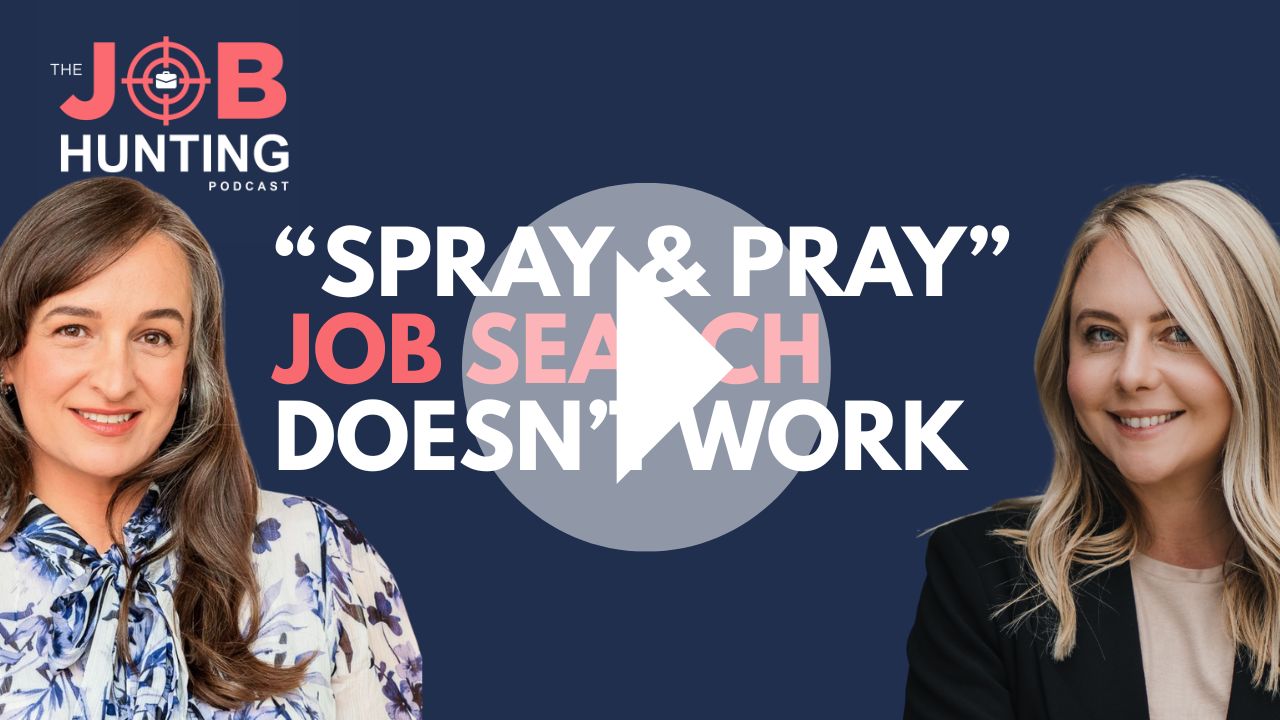
Considering a bold career move? Listen to this week's episode:
To hear the full conversation with Georgie Hubbard and dive deeper into the examples and frameworks we discussed, watch or listen to the episode
- Listen to the full episode on the podcast website
- Listen on Apple Podcasts
- Listen on Spotify
- Watch on YouTube

Time out
- What I'm listening to: Vivaldi, especially the violin and flute sonatas, Samara Joy (I saw her live at the Melbourne International Jazz Festival last weekend). Lily Allen's new album (gosh, I missed her witty compositions, storytelling, and easy melodies), and the (very long!) podcast DOAC roundtable episode about women's health.
- What I'm watching: Nobody Wants This Season 2, and the new season of Grand Designs.
- Current Instagram obsessions: Photos of the inside of instruments, and Japanese noodles that look like objects.
I hope you found this newsletter helpful. Please spread the word and let your friends know they can subscribe as well.
Sometimes people reply to this newsletter to ask if I know a coach who can help them. I get very confused, because I do so much self-promotion! Apparently not enough! Click here to learn more about my services.
Here's to your career success
RBX
Renata Bernarde | Career Coach | Host, The Job Hunting Podcast